

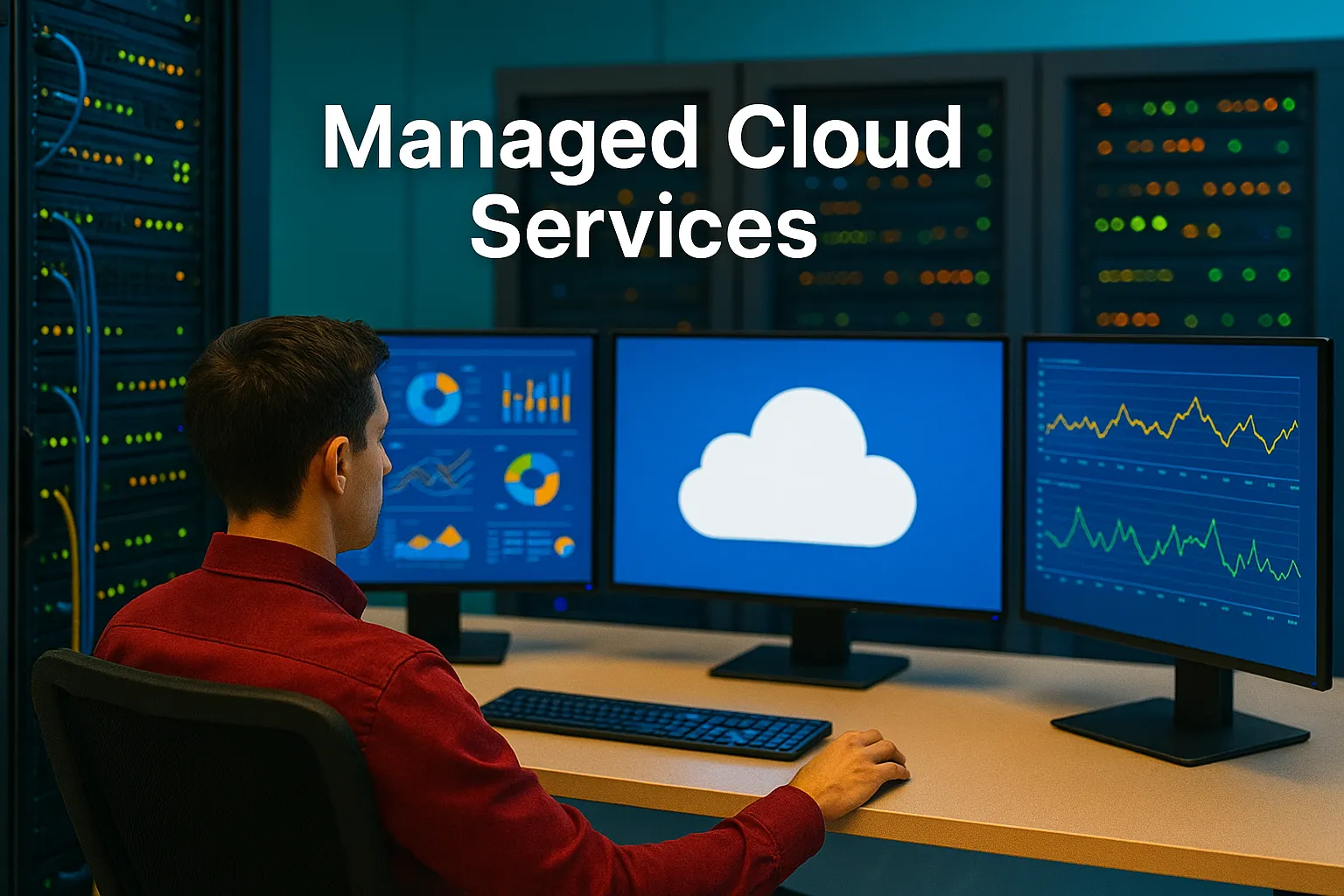

Managed Cloud Services Explained
An overview of managed cloud services, operational responsibilities, and what organisations should expect when infrastructure is professionally managed in production environments.

Understanding Managed Cloud Services and Operations
Introduction
Managed cloud services play a critical role in enabling organisations to operate reliable, secure, and scalable infrastructure without maintaining large in-house operations teams. While cloud platforms provide the underlying technology, managed services focus on the ongoing operational responsibility required to keep production environments stable and performant.
This page explains what managed cloud services involve, how operational responsibilities are structured, and why professional management is essential for production workloads.
What Are Managed Cloud Services?
Managed cloud services refer to the professional operation and maintenance of cloud infrastructure on behalf of an organisation. This typically includes responsibility for availability, monitoring, maintenance, and ongoing operational tasks required to keep systems running reliably.
Rather than focusing on application development or business logic, managed services concentrate on the infrastructure layer, ensuring that cloud environments remain stable, secure, and supported over time.
Operational Responsibilities in Managed Environments
Effective managed cloud services are built around clearly defined operational responsibilities. These responsibilities ensure that infrastructure remains functional, observable, and recoverable during normal operation and unexpected events.
Key operational responsibilities include:
- Continuous infrastructure monitoring
- System health checks and alert response
- Routine maintenance and updates
- Capacity planning and resource management
- Backup verification and recovery readiness
Clear ownership of these tasks reduces operational risk and improves long-term stability.
Monitoring and Incident Response
Monitoring is a foundational component of managed cloud operations. Production systems generate large volumes of metrics, logs, and signals that must be interpreted in context to identify issues early.
Managed services focus on:
- Monitoring service health rather than raw metrics
- Defining actionable alert thresholds
- Responding to incidents in a structured manner
- Documenting incidents and recovery actions
This approach enables faster detection, response, and resolution of infrastructure issues.
Maintenance and Change Management
Cloud environments evolve continuously. Updates, configuration changes, and platform improvements are unavoidable in production systems.
Managed operations introduce discipline into change management by:
- Scheduling maintenance activities
- Testing changes before deployment
- Planning rollback procedures
- Minimising disruption during updates
Controlled change reduces the likelihood of outages caused by untested or poorly timed modifications.
Security as an Operational Practice
Security within managed cloud services is not a one-time configuration task. It is an ongoing operational responsibility that includes monitoring, access control, and continuous improvement.
Operational security practices include:
- Access management and privilege control
- Patch management and vulnerability mitigation
- Secure configuration baselines
- Monitoring for anomalous behaviour
Security becomes more effective when integrated into daily operational processes rather than treated as a separate function.
Why Managed Services Matter for Production Workloads
Production workloads require consistent attention over time. As systems grow in complexity, the operational burden increases alongside the risk of misconfiguration or oversight.
Managed cloud services help organisations by:
- Reducing operational overhead
- Improving response times during incidents
- Providing consistent operational standards
- Supporting long-term infrastructure reliability
This allows internal teams to focus on applications, products, and business objectives rather than infrastructure maintenance.
Conclusion
Managed cloud services provide the operational foundation required to support production-ready cloud infrastructure. By clearly defining responsibilities, maintaining visibility through monitoring, controlling change, and embedding security into daily operations, managed services help ensure that cloud environments remain stable and resilient.
For organisations running business-critical workloads, professional infrastructure management is not optional—it is a key component of sustainable cloud operations.
FAQs — Managed Cloud Services & Operations
Managed cloud services involve the professional operation, monitoring, and maintenance of cloud infrastructure on behalf of an organisation. This includes ongoing operational responsibilities required to keep production environments stable, secure, and supported.
Managed cloud operations commonly cover infrastructure monitoring, incident response, routine maintenance, capacity management, backup oversight, and change control. The exact scope depends on the service model and operational requirements.
Managed services provide continuous oversight of infrastructure, enabling early issue detection, controlled change management, and consistent operational standards. This reduces downtime risk and supports long-term reliability for production systems.
No. Managed cloud services focus on infrastructure operations, while organisations typically retain control over applications, data, and business logic. This model allows teams to focus on development while infrastructure is professionally managed.
Monitoring enables visibility into system health and performance, allowing issues to be identified and addressed before they impact users. Effective monitoring is essential for maintaining availability and operational stability in production environments.
Security is an ongoing operational responsibility within managed services. This includes access control, patch management, secure configuration practices, and monitoring for anomalous activity, rather than one-time security setup.
Explore Our Cloud Services
To explore cloud hosting, virtual machine infrastructure, managed services, and reseller platforms, visit our client portal:
Explore Our Services at Ace Intl Media Portal
For professional web design, hosting, branding, and digital services, visit our official client portal:
Web Design Services: https://portal.aceintlmedia.com/store/web-design
Cloud Hosting & Infrastructure: https://portal.aceintlmedia.com/store/cloud-hosting
Branding & Creative Media: https://portal.aceintlmedia.com/store/branding
SEO & Digital Marketing: https://portal.aceintlmedia.com/store/seo-services
Support & Client Login: https://portal.aceintlmedia.com/login
More About Ace Intl Media
Company Website: https://aceintlmedia.com
Contact Page: https://aceintlmedia.com/contact-us/
Work Phone: +44 1342 621126
Mobile: +44 7403 295904
Email: info@aceintlmedia.com
